
The Flooded Shores
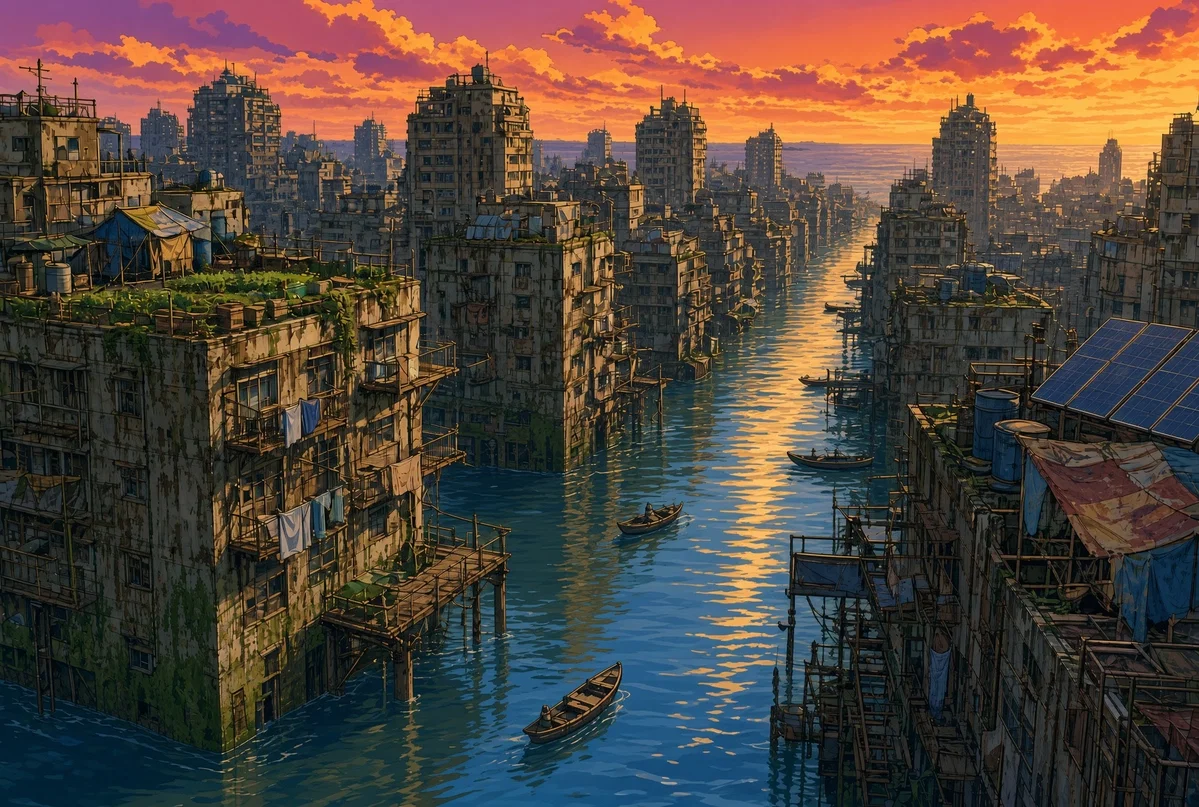
The Lore of the Shores }
In the 2000s they preached global warming. The water would rise, coasts would go, billions would die if nothing changed. That was the public story: heat, weather, ice in general, a drowned future on a poster. Almost nobody talked about West Antarctica as a place already sitting on the sea, or about fire under that ice. It was not the plot. It was a continent at the bottom of a map.
In 2041 the slide started. Calving on the Amundsen coast, rock and ice into the water, a vent under the sheet that held the news for a month. The models stopped sounding like weather. People who could, moved. Height became religion. Ten metres above the then-tide was the line you bought if you had money, or if you were superstitious enough to believe the footage. The rich went first. Then the frightened. Coastal cities got quieter and cheaper. For a while that looked like relief: fewer mouths, less demand.
The water did not stop.
Panic stopped being a storm week and became a generation. By 2091 the people who had waited were wading. Knees in Manhattan, knees in Miami. First floors rotting, the subway a cistern. Venice and the Po went the way everyone always said they would. London’s estuary took the Thames inland whether the city liked it or not. Spain lost its deltas. Denmark counted what was still an island. Japan’s bays — Tokyo, Osaka — learned that a typhoon on a higher sea does not drain; it waits for the next one. Ministries left for ground that would still be ground. The army moved what it called critical infrastructure onto the high contour and called that the country.
The rise did not finish. In 2167 the surge years began. Storms walked over drowned barrier islands onto a sea that already owned the living room. The water barely left. Inland, the relocated state discovered the rest of the map was not empty land. It was full: refugees, ration queues, fever in the camps, martial law that had started as emergency and calcified into government. There was no spare food and no spare dry field. Ships still went to the flooded cities — grain, batteries, medicine when there was medicine — for the people who had never left: scavengers, district bosses, civilians farming roofs and barges. The ships did not take passengers. Solar scrap and rooftop dirt kept a block alive if the block was lucky. Trade if you could. Force if you could not.
By 2231 nobody prints a census anyone trusts. Some went into the water and did not come up. Some tried the inland passage in a boat and were swept, or turned, or shot, because a hungry garrison had orders about extra mouths. Disease and rationing inland are not rumours; they are why the order exists. What is left is two countries that will not use the word. On the coast: a wet city of roofs, tunnels, and men who tax the crates. Inland: a bureaucracy that still signs forms while the shipments slow and the measures get uglier. Neither side has the strength it pretends to. The official world still sends aid so it can say it governs the tide. The tide does not answer.
Life in the Flood }
It is 2231. The sea sits about six metres above the old century’s line and it is not finished. That is enough to kill the ground floor of the low city and to put a one-storey street under. The high interior is still dry. It is not safe. It is full.
On the flood belt you live above the waterline. Streets are canals. The first floor is black water and silt. You cross by roof, fire escape, plank, and barge. Rain is drinking water if you catch it. Food is fish, roof dirt, a crate that made it off a ship, or whatever a crew cut out of a dead office. Storms do not drain the way they used to. After a surge the low wards stay wet and the crossings you used yesterday are gone. Night is for people who know the gaps. A stranger on a roof is labour, a mouth, or a problem.
People who stayed — or who were born after the wading years — keep communes: a block with a painted tide mark, a shared pot, a watch. Some take you in. Some sell you for a filter. Someone always meets the aid ship. That someone is a broker, a marina council, a roof syndicate: they tax scrap, decide who counts as a resident, and keep just enough order that inland can still call this a city. Scavenger crews work the dead floors and the tunnels. Passage-runners sell a way inland. Most of those tickets are lies.
On the fringe the map is half a highway, half a ditch. Checkpoint towns tax both directions. Garrisons hold bridges and river mouths. Salt on your clothes is enough to get you pulled aside. This is where the passage ban is not a rumour. Boats from the wet city are extra mouths and fever. Policy at many posts is turn, sink, or fire.
Inland the country still stamps paper. Ministries fled to the high contour generations ago and called that the state. Ration books, work marks, fever-clear stamps. Camps and depot towns. Fields asked to feed more people than they can. Martial rationing is ordinary. Disease in the queues is ordinary. Officials who still say rescue share buildings with officials who have already written the coast off. Ships still go out with grain and batteries. They do not take passengers back. Old families who bought the ten-metre line in the 2040s sit on private ridges and fund whoever keeps the hill quiet. Chapels and clinics still cross both worlds, which makes them useful and watched.
You can starve in a barge-town and starve in a dry camp. The difference is the water under the bed, and whether anyone inland still writes your district as a place that exists.
This is not a finished apocalypse. The water is still coming, the ships still go out, and no one will let the map stop lying.
Who are you? }
Whoever you are, you learned hunger before you learned a map. Some were born in a dilapidated skyscraper outpost above a street that is a canal. Some were born inland, where even a mother's milk ran thin. Some arrived later, on a hull, and had to pick a side of the waterline before the next count.
As a land-dweller the honest work is labour or a uniform. Both feed you. A labourer has been in the fields, depots, or quarry lines since they were old enough to lift. A recruit enlisted for the bowl and the stamp. Most stay on the high contour: checkpoints, barns, river guns. A few get sent into the flood belt as agents — not marina watch, not a garrison on a bridge. They monitor a landing, a broker, a crate, a name. When a wet district finds them out they are often beaten to a sliver, radio gone, gun gone, and left to learn what survival means with no soil under their feet.
As a belt survivor you live between buildings and rooftops, on parkour lines and lashed bridges, fighting and negotiating for what the ship did not bring. Fish are plenty. The wrong catch still puts you on your back. You salvage wrecks and dead upper floors for tools, cloth, timber, wire. Generations on, there are fewer of you. That means more empty rooms, not an easier life.
Or did you come in on a boat from elsewhere — another flood belt, another coast, a crossing of the Pacific or the Atlantic? That is yours to say.
The world does not care which door you used. It cares whether you eat tomorrow, and who thinks you belong on their roof.
OPTIONS }
1: Open Scenario. (Write Your Own)
2: Agent for the Inlands.
3: Running a message.
Author Notes }
Have been playing a lot of Dying Light and have simply been wanting something like this without the zombies, but eh. The Image is kind of meh generated with Grok because I am lazy, but hope you enjoy the bot.
Created Sep 13
Updated Oct 21
Published Sep 13
proxy allowed